


The alien in my house. Often, when I’m trying to figure out what’s going on in my kid’s head, my thoughts turn to this quote from the perfectly named historian H. W. Brands: “History is trying to reconstruct the psychological states of dead people by reading their mail.”
My son 1) is alive and 2) doesn’t get any mail, unless you count the occasional medical bill in his name. But other than that, reconstructing his mental state is a similarly opaque process. Occasionally his internal goings-on are obvious: laughing because he’s using a flowerpot1 as a hat, or protesting when I won’t let him play with an extra-sharp Japanese knife that’s already severed the tip of my own finger once. But most of the time his internal experience is an utter mystery. And counterintuitively, the more he acquires language, the more the mystery deepens. Except for when he’s expressing very basic desires—more, water, etc.—the couple dozen words in his vocabulary serve not to explain his inner state, but to hint at its incomprehensible depths. For example: Why are almost all animals “doggies”—dogs, cats, squirrels, giraffes—except for the rabbits in Goodnight Moon?
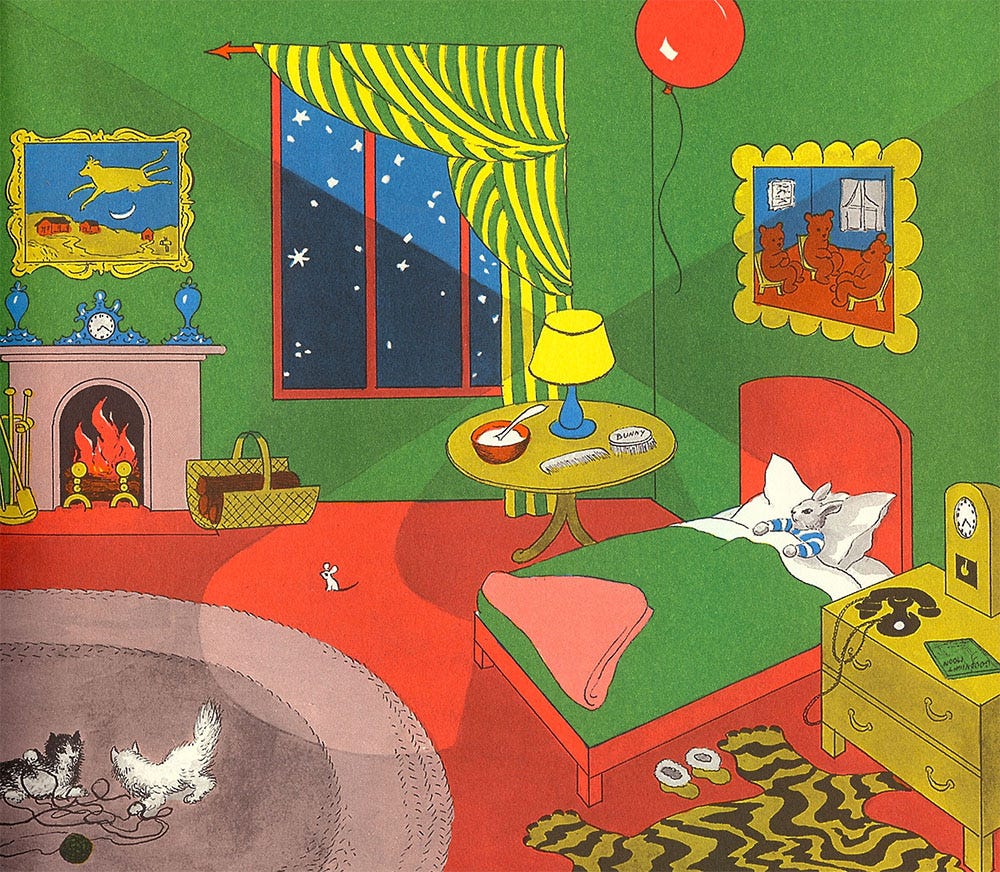
Sometimes little kids seem more human than the rest of us, adults reduced to their purest, most essential form. Other times, it’s like having a needy roommate who’s also an alien. If we ever do need to figure out how to communicate with otherworldly beings, I suggest we send a team of child psychologists.

Compound interest. The standard explanation for why we find our children so interesting is that evolution forced us to. The only species that can survive without such interest, the story goes, are those like the Atlantic cod, whose females lay millions of eggs each year and are thus spared from being particularly attentive to any one individual.

But do I pay attention to my child because I find him interesting, or do I find him interesting because I pay attention to him? After all, sustained attention can make almost anything interesting. On a meditation retreat a few years ago, I became fascinated by things I wouldn’t typically notice: the movements of a particularly shapely tree, the subtle shifts in the breeze, this one squirrel’s frenzied nut relocation. Now, I obviously don’t think a squirrel carrying a nut around is as interesting as my own child. But they are perhaps not as far apart as they seem at first glance. (Even their actual activities are similar: my son also spends most of the day carrying objects from one place to another.)
The stereotype, at least as I was made to understand it, is that family life is a death sentence for novelty, that having children means trading adventure and freedom for routine and repetition. Well, I do have less freedom now, but I don’t have any less novelty: turns out having a kid is basically just installing a perpetual novelty machine in your house. It’s been a surprisingly effective treatment for my compulsive novelty-seeking.

Parenting tips from Stalin. A favorite pastime of all New Yorkers is gawking at the antics of rich people—“rich” here always defined as “anyone richer than you.” The latest in the discourse: this Wall Street Journal article, one in a long line of stories about wealthy families with entire childcare staffs. Of course, people have been paying others to take care of their children for as long as the concept of paying anyone to do anything has existed; what fascinates me about this particular iteration is the way these families, by cloaking their decisions in the language of optimization, deny that any tradeoffs exist:
Most nights, the family assistant takes care of bath time. [So-and-so] also hands off what she calls “repetitive play,” reading the same book five times or watching her toddler open and close a door for 45 minutes. “Every hour I’m not bogged down with the doing is an hour I get to show up fully present with my kids.”
[Another so-and-so] relies on a household team of nannies, cleaners, a chef and a chief of staff, which helps afford time for “high-impact, core memories” like vacations with her children. “If getting help with the logistics means I can spend my time focused on the moments that really matter with my children, I don’t see that as outsourcing parenting,” she said. “I see it as being intentional about where I spend my time.”
It sounds so simple: outsource the rote tasks, double down on the quality time, everyone wins. Except… doesn’t everyone know that there’s not actually any such thing as “quality time”? Or perhaps it’s more accurate to say that quality time is real, but can only arise spontaneously. Like an erection, it can sneak up on you at any time, and planning for it is a reliable way to ensure it won’t happen. Changing a diaper can be quality time; a family vacation can turn out to be… whatever the opposite of quality time is, anyone who’s ever been on one knows. Even our society’s most idealized portrayal of relationships—the romantic comedy—never shows couples falling in love through “quality time,” but rather through small, everyday moments: the lobster scene in Annie Hall, watching TV while on the phone together in When Harry Met Sally, browsing the record store in Before Sunrise.

Very few of the memories that have defined my first eighteen months as a parent happened during so-called “quality time.” Most of them are from times when we were just fucking around, or during activities that could even be categorized as drudgery, and that I might have been tempted to outsource if we too had a household staff. The time he mimicked my sponging down the kitchen table, doing his own “cleaning” with a dumpling instead of a sponge. The time he threw all his food on the floor and then immediately began wagging his finger and scolding himself “No no no!”
I even treasure some memories that were objectively awful at the time: when he was around six months old, I woke up from a night out with coworkers more hungover than I’d been in years, and in a futile effort to avoid having to get up, I brought him into bed with me, where he immediately pooped all over himself, the bed, and me. In the moment I was certain that nothing worse had ever happened to anyone throughout the entire course of human history, but now it’s just another funny story, and when I’m wracked with liver spots and dementia it’ll be one of my few remaining memories, right next to the time my friend Alex’s pants fell down while he was running for the school bus and the jingle for Water Country, a water park in Portsmouth, New Hampshire, that I’ve never actually been to.
Look, it’s not like I think there’s anything inherently wrong with having someone else take care of your kids sometimes. (I’m writing this very piece while someone else takes care of mine.) It’s probably impossible to have a really high-achieving career and spend a ton of time with your family, and I don’t think it’s an inherent rule in every situation that choosing your career is choosing wrong. (And of course all the people in this article are women; a man outsourcing childcare isn’t a story.)
Just don’t tell yourself you’re not missing anything! What looks like drudgery from far away sometimes feels different up close. And even the genuinely mundane moments—the kind so unmemorable that I can’t even summon any specific examples for this piece—often become more than the sum of their parts when accumulated day after day. No single bath time is all that special, but the subtle progression of a hundred bath times strung together is. As the (probably apocryphal) Stalin quote goes, “Quantity has a quality all its own.”
I learned when spell-checking this essay that “flowerpot” is one word. Who knew?