

Here’s a common misconception about writing: that the point is to tell the reader what you think. How lame! Sometimes I catch myself starting to tell you all what I think, and it’s like… ewww. Gross. Who cares what I think? I don’t even care what I think, most of the time, and I’m me.
Besides, even if I did want to tell you what I think, I couldn’t, because I don’t actually know. If you look up writers’ quotes about the act of writing—which I recommend against, for obvious reasons—you’ll find all kinds of quotes about how they don’t know what they think when they start, but rather discover it through the act of putting words together. In my experience, those quotes are half true. I don’t know what I think when I start writing. I also don’t know what I think when I finish.
Some writers excrete take after take with the nonchalance of a farting dog. They’re so full of opinions that they can’t stop them from leaking out. I think I have opinions, but once I start writing them down and have to decide if I actually believe them? Forget it. The thoughts that seem so wise in my head, or coming out of my mouth, reveal themselves as nonsense on the page, like how you sometimes catch your reflection in the side of a glass-walled building and realize just how ugly you’ve always been.
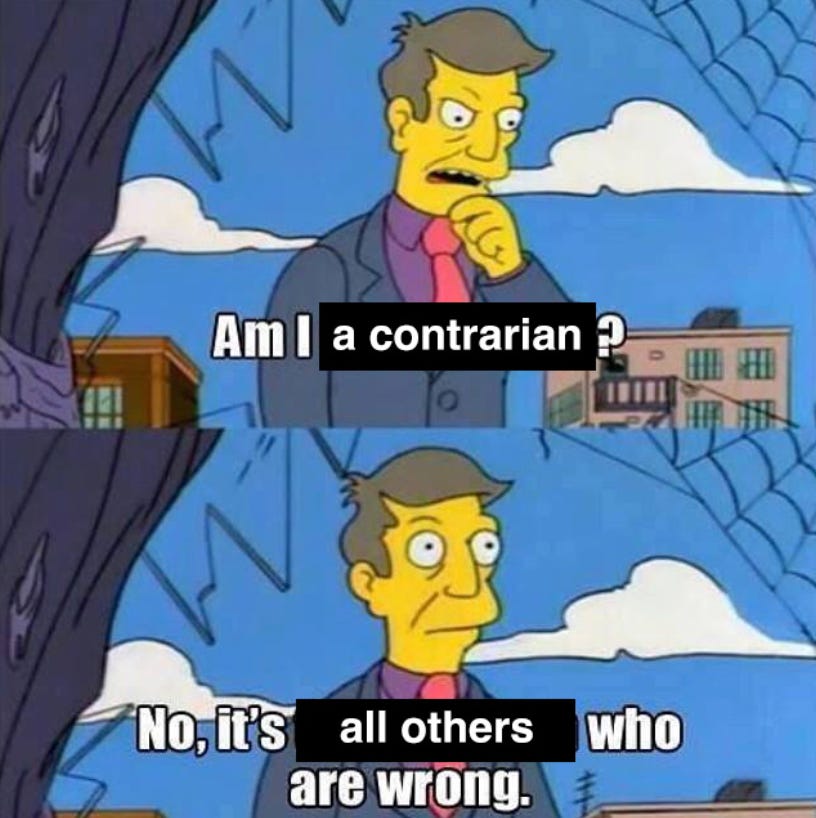
My wife calls me a contrarian because of the way I instinctively take the other side of any argument, but she’s wrong. I’m not a contrarian; I’m a shit-stirrer. Contrarians are the bad kind of annoying: they genuinely think they know better than everyone else. Us shit-stirrers are the good kind of annoying: we just like throwing crazy opinions out there to see what happens.
You know who tells you what they think? Plagiarists.
I mean, not literally: by definition, plagiarists pass off others’ thoughts as their own. But the type of stuff that most often gets plagiarized tends to be pieces of the “writer tells you what they think” variety. Start with a few facts—pulled from a book, or the news, or maybe an obscure academic study—add a dash of opinion, and call it a day. You know the type: this person in politics is bad. Dating apps, perhaps, have some downsides. Something is wrong with the young people—they’re drinking and fucking too much, or perhaps not drinking and fucking enough. These are the kinds of articles we all “plagiarize,” in a way, when we repeat what we’ve learned from them at a dinner party as if it’d just sprung into our heads fully formed like reverse Athena.
Plagiarism scandals are great because nobody involved got hurt that badly, all things considered, so you can gossip about them as much as you want without feeling even the slightest twinge of guilt. And every day there’s a new one. This week it’s Ross Barkan, whose seemingly inhuman prolificness was revealed to have been achieved the most human way of all, by copying from others. Before him, there was Maalvika, a young writer who was two things a writer should never be—1) a former TikToker and 2) hot—and who was climbing the Substack charts until someone noticed that she was also a third thing a writer shouldn’t be, a plagiarist. I’m sure there will be another soon, and another after that, each one very much like the last—which is fitting, because why should a plagiarist have an original scandal? The bottomless depths of the internet mean there’s never been more source material to plagiarize from. And on the internet, no one knows you’re a plagiarist… until everyone does.
But what really strikes me about all these scandals is just how anodyne all of the writing involved is, original and plagiarized alike. Maalvika’s copy-pasted ideas were all so cookie-cutter that the original essays she was plagiarizing from also read like plagiarism. In his newsletter, Barkan writes original pieces like this elegiac Pet Sounds retrospective, and no one is accusing him of plagiarizing those; the pieces he got in trouble for are all quick-hit, slop-adjacent takes like these ones:
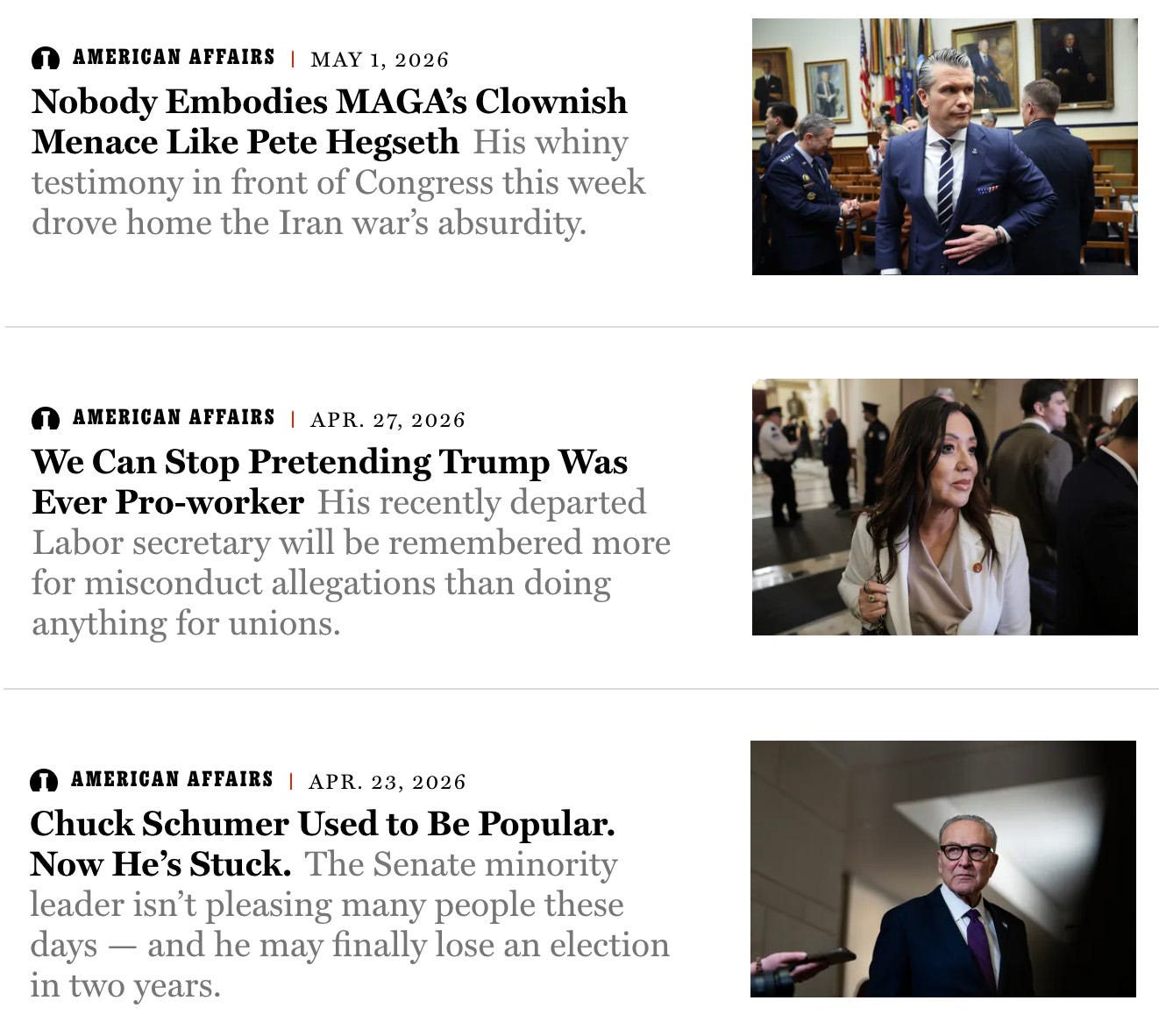
Now, look: I’m obviously not saying anyone deserves to get plagiarized, any more than one deserves to have their freshly baked pie eaten just because they left it on the sill of an open window. But this kind of writing is just inherently plagiarizable.

So how do you become un-plagiarizable? One strategy is to get personal: Joe Biden notwithstanding, no one is going to plagiarize your autobiography. Another is voice: when it’s distinct enough, it’s laughable to think of someone trying to pass your words off as their own. How would one plagiarize Patricia Lockwood, or David Foster Wallace, or Jonathan Ames? We don’t read those writers’ work to find out what they think; we read it to take a skinny-dip in their brain. Another technique is to write stuff that’s so fucked up that no one else would even want to put their name on it. As the novelist Jacqueline Susann said of Philip Roth: “He’s a fine writer, but I wouldn’t want to shake hands with him.”
Or think about it this way: don’t write the kind of stuff that anyone could write. Because eventually, anyone will.

In 2026, any essay about plagiarism is really an essay about AI, and this one is no exception. Most of us don’t have to worry about being ripped off by human imitators. But soon enough, AI will mean infinite Maalvikas everywhere. (If Elon has his way, they’ll even be hot.)
Anyone who claims they know for sure what the AI future holds is either deluded or trying to take your money. But when that world comes, I suspect that these same techniques will produce the kinds of writing least likely to be obviated. Personal stories. Voice. Getting weird as hell. And if you must tell people what you think, then for the love of God, please try to think something interesting.
Then again, I can’t help but notice that the traits I listed as making for the best, most future-proof writing just so happen to line up exactly with the kind of writing I already aspire to. Perhaps it truly is a coincidence that my impartial analysis has led me to conclude that I’m already doing everything exactly right. Or perhaps I’m just like Marc Andreessen, blithely proclaiming that machines will soon be able to do every job there is… except his. (Meanwhile, having worked with many VCs, I can confidently say that there already is a machine that can do their job. It’s called an ATM.)
The truth is, I don’t actually think you should write like this because it’ll make your writing AI-proof, or plagiarism-proof, or for any other instrumental reason. I think you should do it because it’ll give you the best shot at writing something good. Or at least, at writing the kind of thing I’m personally most interested in reading. If AI somehow gets really good at writing weird personal essays, but can’t produce 500-word political takes, you’ll still never see the words “Pete Hegseth” in this newsletter unless he becomes a subscriber and writes in.
But I’m getting dangerously close to telling you what I think. So let me close with this reminder: maybe I have no idea what I’m talking about. Maybe I don’t believe any of this. And even if I did, I’d never tell.