

When you’re about to have a baby, you quickly learn two things about those who already have one. The first is that nothing you can do will stop even complete strangers from regaling you with their thoughts about parenthood, whether you want them to or not. (In fact, the length of these monologues tends to be inversely correlated with your level of interest.)
The second is that almost all of these people’s thoughts are identical. Sure, the specific words vary, like a college student hastily disguising a paragraph copied from Wikipedia. But underneath it’s just the same few clichés regurgitated over and over. They grow up so fast. Everything changes overnight. It’s hard, but it’s worth it. And of course, it’s impossible to explain to anyone who doesn’t have kids themselves—not that this ever stops anyone from trying to explain anyway.

I desperately hoped that when I became a parent myself I’d find that these clichés didn’t capture my own experience. Of all the possible ways parenthood might change me, the one I feared the most was that it would turn me into the kind of person who spoke about one of the biggest experiences of my life exclusively in hand-me-down platitudes.
So: a year or so into parenthood, what’s the verdict? Unfortunately, my answer thus far is extremely unsatisfying. I wouldn’t necessarily say the clichés are true. But also, I wouldn’t say they’re definitively not true. Like most clichés, they exist in that annoying grey area where it all depends on how you look at them.

In the first draft of this piece, I was much less wishy-washy. I confidently declared that many of the most common parenthood tropes were wrong, and furthermore, that anyone who repeated them as if they were true was an idiot or a liar or both. I even found a way to work a Joseph Goebbels quote in there (don’t ask). But unlike Goebbels, the more I explored my ideas, the less sure of them I felt.
For one thing, like every other parent, I’m deluding myself if I think I know very much about “parenthood” writ large: we are all extrapolating from an extremely small sample size. Really, all I know about is the experience of parenting my particular child. And even then, he acts differently with other people than he does with me!
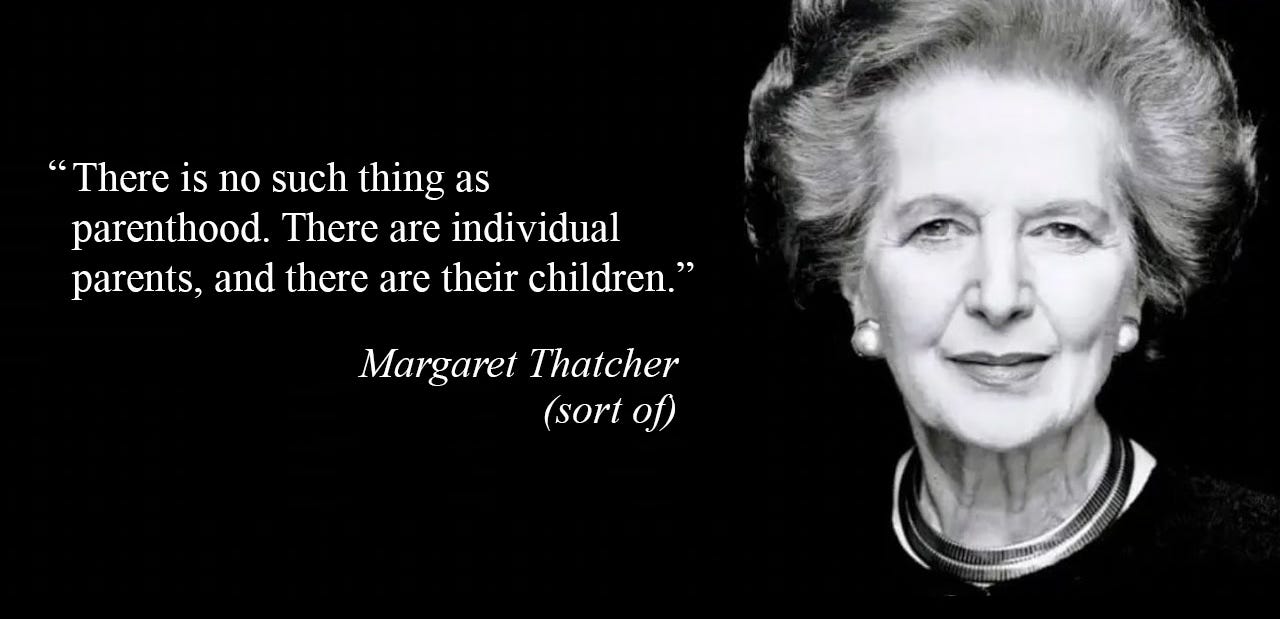
It’s begun to strike me as kind of odd, actually, the way we talk about parenthood as if it’s one uniform thing, when really it’s a contingent relationship with a specific person. I guess we generalize similarly about falling in love, but we tend not to do this with other types of relationships—you much less often hear people talk in such sweeping terms about having a friend, or working for a boss, even though most of us will have many more friends and bosses than lovers or children1.
In cases where I do think the conventional wisdom is genuinely wrong, it tends to be wrong less by being outright false and more by being gently misleading. For example—and this is embarrassingly basic—no one told me how fun parenting would be! Granted, it’s not like anyone explicitly told me it wouldn’t be fun, but from the way people talk about it you’d think most of parenting was in the “hard in the moment, glad you did it later” category, the kind of experience that a certain kind of annoying person loves to call “type 2 fun.”
But actually, I find the day-to-day experience quite fun in the normal, type 1 way, full of little moments of delight. For example: my kid understands the mechanics of drinking from a straw, but he has yet to master the timing, so each time, he opens his mouth as wide as it’ll go well before the straw is anywhere near him and then just sits there with his ridiculous gaping maw as he sloooooowly brings the cup to his face2. Or there was the time he discovered that grabbing his penis in the bath made us laugh and then started doing it over and over until we were fully in hysterics. (I don’t know why the pediatrician never alerted us about this important developmental milestone.)

Then there are the cases where the cliché actually is kind of right, just not in the way I’d originally interpreted it. Take the trope that parenthood brings meaning to one’s life. So far, at least, this has not happened for me in the way I thought people were saying it would. I did not have one of those movie-scene experiences where I looked at my newborn son and suddenly felt that everything had changed forever; I do not feel like parenthood has given my life a sense of purpose that was lacking before, or altered my deeply-ingrained sense of cosmological nihilism.
Instead, parenthood has enhanced my sense of meaning in much the same way meditation does: by forcing me to be more present, more attuned to the small moments of beauty and joy that are everywhere if you can just slow down enough to notice them. By day four of the silent meditation retreat I went on a few years ago, I was spending an hour or so each afternoon watching a squirrel prance around the backyard of my cabin, finding great pleasure in his goofy movements. Having a baby is kind of like that, except millions of years of evolutionary instincts mean it doesn’t take 96 hours of silent contemplation to get me into the right mental state to pay close attention to my child.
Another way parenthood has increased my sense of meaning: it’s made me way too busy to ruminate on unhelpful questions like “What is my life’s meaning?” Which is not a knock against it—there’s a reason life in a monastery involves an endless succession of mundane chores.

I’ll leave you with one last thought about all these clichés: I’m starting to think that hearing them over and over might be rotting our brains a little.
If you’ve ever taken a drawing class, you’ve probably heard the thing about how learning to draw is really about learning to see. Beginner artists tend to default to symbols and shorthand, drawing what they think a face or a chair or a banana looks like instead of the far more complex image that’s actually in front of them. Art teachers have all these little tricks to defamiliarize the world and force their students’ brains to actually see what they’re looking at: drawing something upside-down, for example, or drawing the negative space around an object instead of the object itself.

That, in my best moments, is what I’m trying to do with parenthood: pretend I’ve never heard any of the clichés, that no one ever stopped me in the street and told me that I’d never be the same again or that this would be the hardest job I’d ever had, and just really, truly see what’s in front of me.
You might say I’m trying to look at my son the same way he looks at a straw: with rapt attention, a wide-open mouth, and absolutely no idea what’s going to happen next.
If you liked this one, you might enjoy these other parenthood-related pieces: Having a Kid Is Already Fucking Me Up and He Hasn’t Even Been Born Yet, and Sketches from Parenthood, Days 1–30 and Months 2–6.
Not that these are always mutually-exclusive categories. I mean, hopefully “children” is. But not the other ones.
If you’ve ever made out with someone who opened their mouth before you closed your eyes, it pretty much looks like that.