

1.
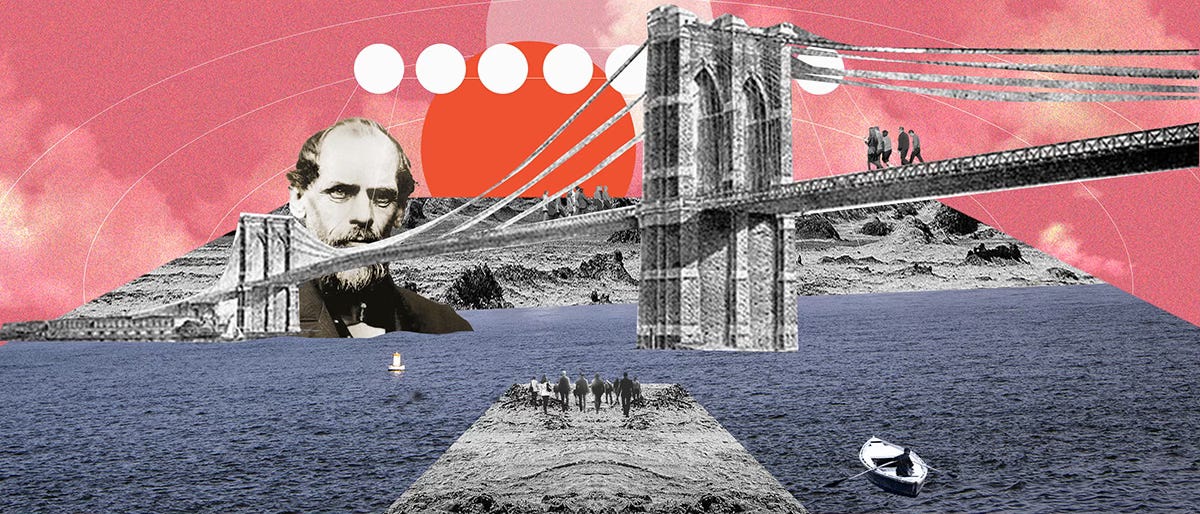
This book is largely the story of two guys: civil engineer John “Hey, That’s the Guy the Street’s Named After” Roebling, and his son Washington. Roebling Sr. conceived of, designed, and advocated for the bridge, but Roebling Jr. was the one who actually got most of it built, after Senior, while out location-scouting for the bridge, got his foot crushed by a ferry, refused medical treatment, and died of tetanus. The book, however, is framed not as a biography of these men, but as a biography of the bridge itself.

These days there are lots of history books about objects, and they’re easy to spot because they all follow the same dumb title format: Boxer Briefs: the Renegade Undergarment that Split the Difference and Changed the World or The Doorstop: How a Forgotten Wedge of Wood Propped Open the Gates of Progress. But this framing was much less common in 1972, when The Great Bridge came out. I commend David McCullough both for the original approach and for not giving his book a stupid subtitle.
2.
It was probably inevitable that the Brooklyn Bridge, or some equivalent, would have one day been built: the economic logic of connecting Manhattan and Brooklyn would eventually be indisputable to even the most diehard naysayers. But as with much of the world, what seems obvious now was far from obvious at the time. When the bridge was first proposed in 1852—and for much of the next 31 years until it opened to passengers—a significant percentage of the public considered the idea to be some mix of unnecessary, too expensive, or outright physically impossible. After all, ferries—of which there were over a thousand per day—worked just fine1.
Without the Roeblings, the bridge could have easily taken another decade or two. The next NYC<>Brooklyn crossing, the Williamsburg Bridge, wasn’t completed until 1903, and its financing and political support were heavily dependent on the Brooklyn Bridge having already proved its success. Or we could have just ended up with a bridge that was much uglier: the Roeblings’ deliberate attention to design and aesthetics was unusual for an era when most bridges prioritized engineering efficiency over visual appeal.
3.
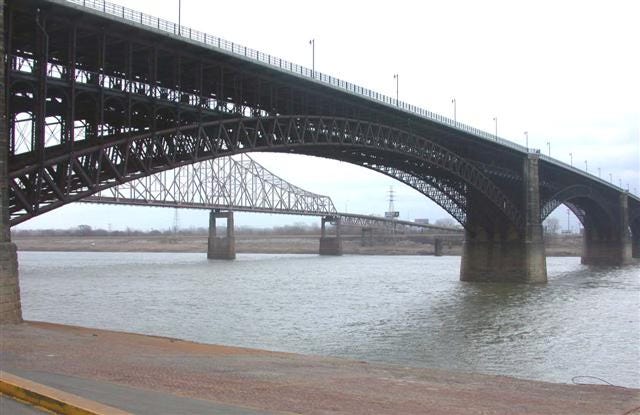
The fear that a suspension bridge over the East River was physically impossible wasn’t unwarranted. Bridge collapses were a common occurrence in the 1800s, and they often destroyed their makers both financially and psychologically. In 1879, for example:
The new Tay Bridge over the Firth of Tay, in Scotland, one of the biggest, most famous bridges in the world, gave way in a gale and collapsed into the sea, taking with it a train carrying seventy-five people, all of whom were killed. The bridge was the work of Britain’s leading engineer, Sir Thomas Bouch, who had been knighted by Queen Victoria that June. His bridge, a series of trusses, had been built mostly of wrought iron, however, not steel, and subsequent investigations of the disaster indicated that he had not calculated his wind loads accurately. The conclusion was that the engineer was mainly to blame. (His health and mind broken by the ordeal, Bouch died in less than a year.)
Tough break for Bouch obviously, but I actually think there’s something darkly heartwarming about how seriously these bridge-builders took their public responsibilities. Compare that to today: I’m not aware of any Boeing executives who had their health and mind broken by the 737 MAX disasters, or any pharma execs killed by their grief over the opioid crisis. If I'm driving over a bridge, I kind of want to know the guy who designed it would be destroyed if it collapsed.
4.
This is hardly an original observation, but it’s striking how much more risk-tolerant American society was in the 1800s. There are the obvious examples, like how lax construction-safety standards were—27 people died building the Brooklyn Bridge, an order of magnitude more than you’d expect for a comparable project today. (Though to be fair to the people in charge, this was on the lower end for the era, and most of the deaths seem to have been caused not by cheapness or carelessness, but by the limited state of technical and scientific knowledge at the time.)
But it’s the smaller stories of insane-to-modern-ears risk tolerance that really stuck out to me. My favorite: after the suspension cables had been hung across the bridge, but before the actual span had been built, the engineers set up a narrow wooden footbridge as a temporary tourist attraction. Anyone could walk across for 50 cents (a hefty sum at the time), and tons of people did, even though the footbridge had a tendency to sway terrifyingly in the wind and a single slip could send you plummeting to your death. When bridge management finally did close the footbridge—after a guy had a seizure midway across and very nearly fell off—much of the public thought they were being overly cautious.
5.
The workers who built the bridge risked their health and safety in ways we wouldn’t tolerate today. But unlike their modern counterparts, the men in charge were right there with them.
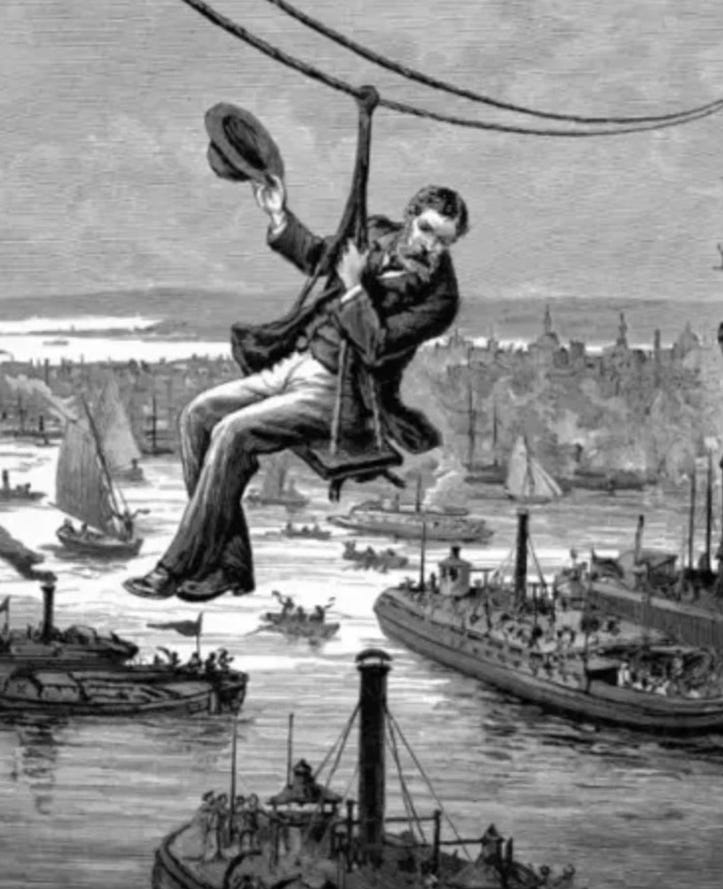
E.F. Farrington, one of the project’s top engineers, was the first person ever to cross the “bridge”—a word I put in quotes here because it wasn’t even really a bridge at the time he went across. Explaining that he would never ask one of his men to do something he wouldn’t do himself, Farrington rode across a single steel cable connecting the two spans in what was essentially a seat jury-rigged to a pulley. Oh, and did I mention he was 60 years old at the time??
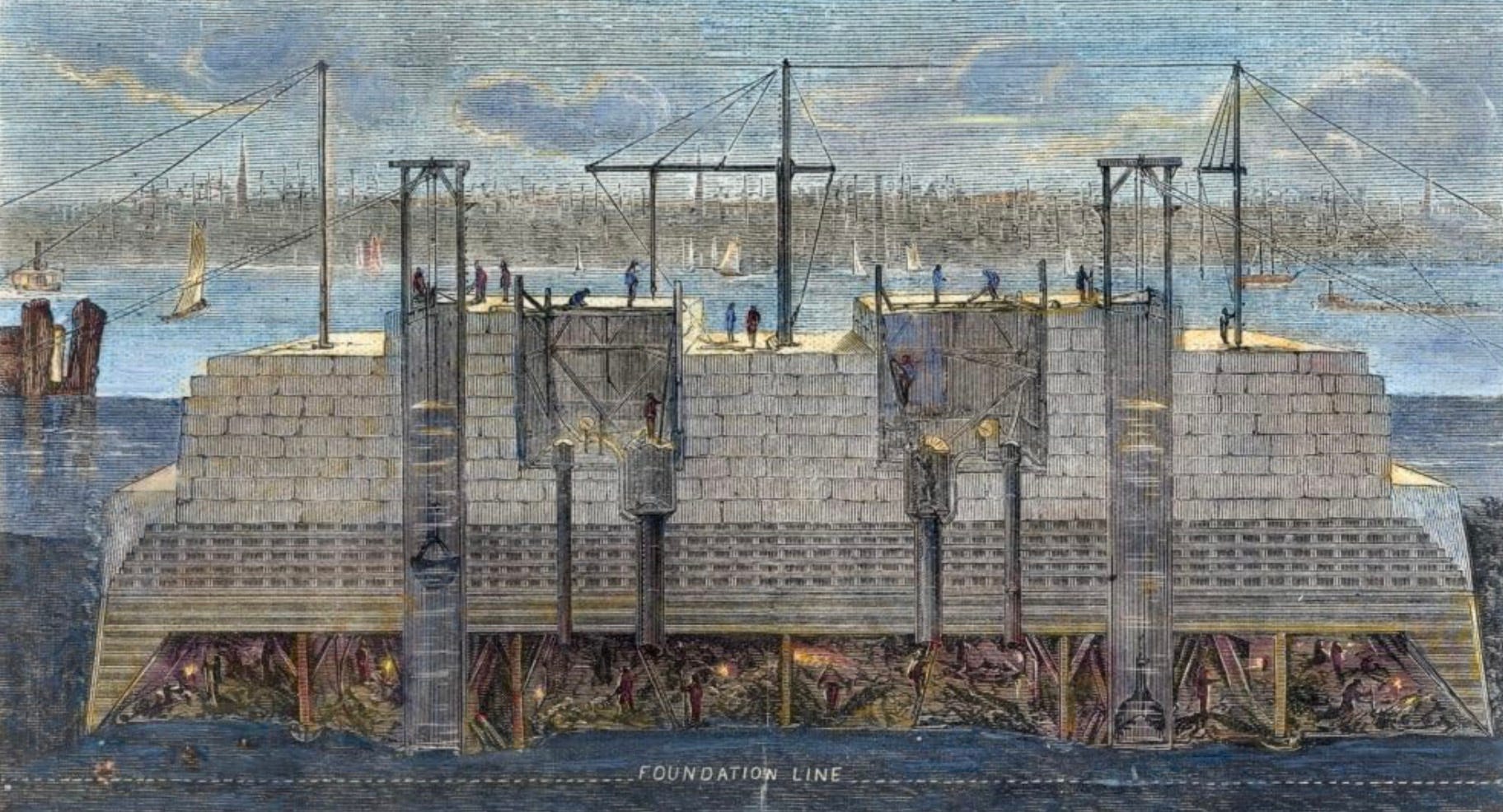
Chief Engineer Washington Roebling, meanwhile, went down into the underwater foundations2 with his workers so frequently that he developed a case of decompression sickness he never recovered from. He somehow oversaw the final ten years of construction entirely by letter, while he remained confined to his home3. More than half of the people who worked on the bridge never once saw him in person.
I don’t think there’s any single explanation for why this culture—of the big shots getting their hands dirty with the little guys—has changed so much in the intervening years. But one factor has to be that when the Brooklyn Bridge was built, there was really no such concept as “management.” The men in charge were all themselves engineers, and they saw little distinction between coming up with the idea for the bridge, doing the scientific and engineering work to make it possible, and running the company that got it built. It would have seemed ludicrous that one could play a significant role in the design or construction of the bridge without being physically on site.
No one can write about a large public works project without mentioning Robert Moses at some point, so here goes: his reign almost a century later is an instructive contrast. Moses’ most essential skill wasn’t designing infrastructure, but mastering the levers of power that enabled him to make things actually happen. Calling him “not an engineer” is an understatement: despite being responsible for more New York City roadways than any other single individual, he never even learned how to drive.
6.
One thing I always enjoy when reading history is placing whatever I’m reading about alongside other, unrelated things that were happening around the same time. Here’s a fun one for the Brooklyn Bridge: only a few years before it opened, a coalition of Native American tribes defeated Custer’s army in the Battle of Little Bighorn. There’s something wild to me about these two events, which feel like they belong to entirely different eras, happening side by side. At one end of the country, a bridge so technologically advanced that even in 2026, 143 years after it opened, it’s still carrying hundreds of thousands of people a day. At the other, an army on horseback defeating its enemy largely with bows and arrows4.
A couple of other great pairings: The first fax machine was invented the same year the Pony Express launched. The New York City subway overlapped with the existence of the Ottoman Empire for eighteen years. The last verified widow of a Civil War veteran lived until 2020.
7.
When the Brooklyn Bridge was built, parts of Brooklyn were still farmland, and Manhattan was so underdeveloped that the bridge’s towers were the city’s tallest structures except for the spire at the top of Trinity Church. For its first few decades, human passengers shared space with livestock, who were charged dedicated tolls (five cents per cow and two cents per sheep or hog—a bargain!). Nonetheless, the bridge was designed with such foresight that it was later able to start handling cars and trains with no significant modifications, and is first major structural revision wasn’t needed until the 1940s. By comparison, the projected lifespan of a new bridge built today is only 50–70 years.
8.
The Roeblings (and others of their era, like Frederick Law Olmsted and Chicago planner Daniel Burnham) were a type of guy who doesn’t really exist anymore: the ambitious visionary, eager to make their mark on the world, who does so via the pursuit of grand public works. These guys weren’t exactly government employees, but they weren’t exactly entrepreneurs either; they needed political patrons, public financing, and democratic buy-in, but they drove the vision personally.
Today, someone with that kind of personality and drive would go into the private sector, or maybe seek political office. But they wouldn’t operate in that middle space between public and private, because it doesn’t really exist anymore. The Brooklyn Bridge endures not just as infrastructure but as a physical artifact of a time when this kind of ambition got channeled into public life.I suspect that part of the reason it remains so beloved today is that, as with a great work of art, people can on some level feel the personal care of its makers seeping through, whether they’re consciously aware of it or not.
Thanks for reading! A few closing notes:
If you liked this piece, please let the world know by hitting the heart button at the bottom. I haven’t made this ask in a while because I find begging for likes to be incredibly degrading, but it really does help people discover my writing.
As an experiment, I enabled comments for the first time ever on the JFK piece. The results of the experiment were ambiguous (no topic brings out the crackpots quite like the JFK assassination), so I’m leaving them on for this piece too, and we’ll see what happens.
If you liked the JFK piece: 1) You are insane. 2) You might also like some of my other tumbles down American politics rabbit holes:
Book Review: The Outlier

Everything you didn’t realize you wanted to know about Jimmy Carter, including his early-career fake racism, the White House glove rebellion, and the Great Balloon Failure of 1980. At 6,000 words, this article is almost longer than Carter's actual presidency!
Public Interest Law and the Paradox of Justice by Lawsuit

In which Ralph Nader kickstarts a new kind of political activism and accidentally paralyzes the government.
Phew! Long postscript. That’s it. Thanks all!
—Max
The ferries worked except when they didn’t: the East River froze every few winters, bringing intercity traffic to a standstill except for those brave enough to walk over the ice. (That’s right, intercity—Brooklyn was its own city until 1884, when it became part of New York City after a public referendum in favor of the merger passed by a mere 277 votes.)
The technical term is “caissons”; don’t ask how much of my time reading this book was spent repeatedly looking up the technical terms for different parts of a bridge.
Or did he? His wife Emily Warren Roebling, originally seen merely as the conduit between her husband and the outside world, is now understood to have played a significant role in the project. Wikipedia full-on says that she “took over much of the chief engineer’s duties including day-to-day supervision and project management”; McCullough is a little more circumspect.
Contrary to the stereotype, the Native American forces did have some guns, but the majority were using older forms of weaponry.
so happy to see you blogging about these things. keep it up!
Enjoyed reading. I thought " I Kind of Want to Know the Guy Who Built It Would Be Ruined If It Collapsed" was going to be a warning about some future autonomous AI engineer! That wouldn't be such an interesting story.